VOKA

Fetal lie

Table of contents
Transverse and Oblique Fetal Lies Incidence Pathogenesis and Risk Factors Diagnosis Ultrasound Confirmation Complications Labor Management Procedure-related risks Procedure Premature Rupture of Membranes Transverse lie of second fetus after birth of first fetus Specifics of cesarean section

Transverse and Oblique Fetal Lies

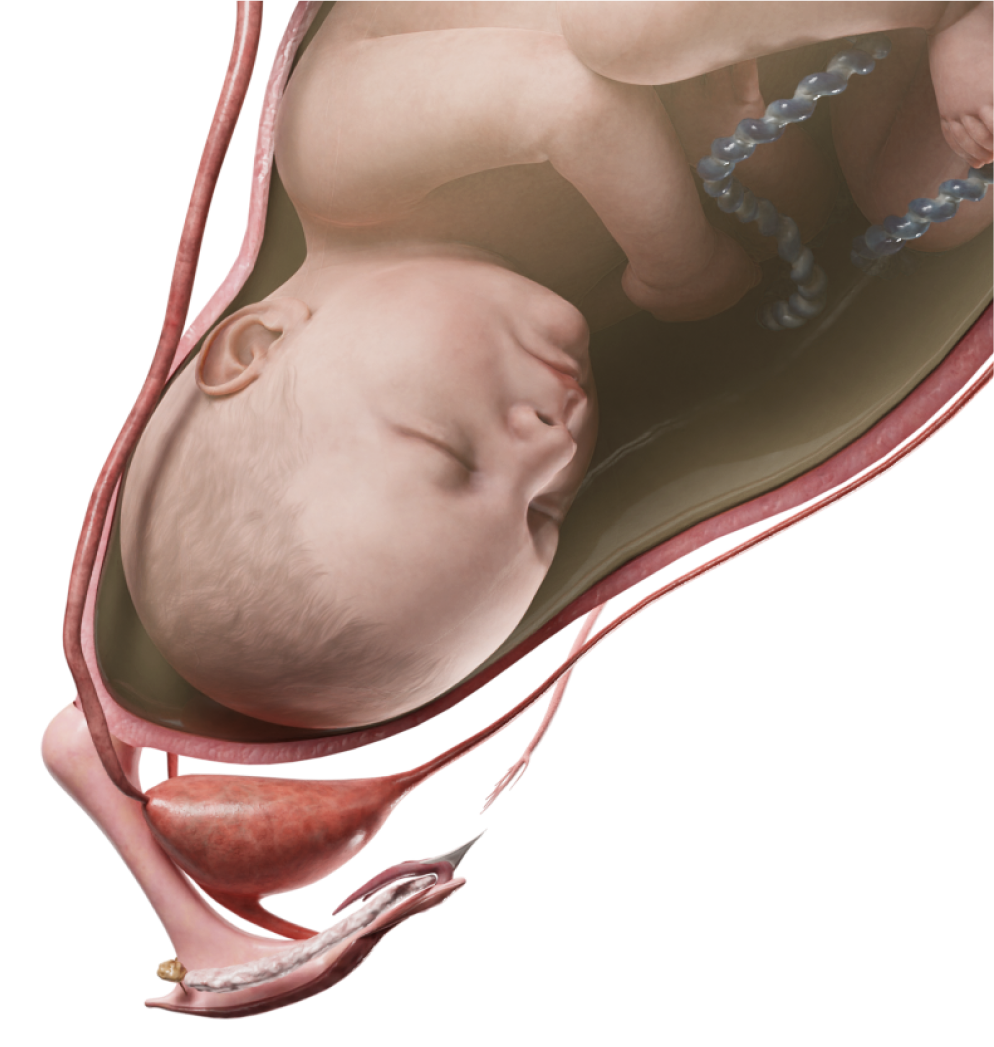
The fetal lie refers to the relationship between the axis of the fetal body and the longitudinal axis of the uterus. A longitudinal fetal lie occurs when the two axes are parallel, whereas a transverse lie indicates that the axes are perpendicular. In cases of an oblique lie, the fetal body forms an acute angle with the axis of the uterus. The occiput anterior presentation, with the fetal head flexed and the body aligned along the axis of the uterus, is considered optimal for delivery.

The transverse lie is diagnosed when the fetus is positioned perpendicular to the longitudinal axis of the uterus. Two variations exist:

  • The curvature of the fetal spine is oriented downward (referred to as dorsoinferior); the fetal shoulder presents at the cervix;
  • The curvature of the fetal spine is oriented upward (referred to as dorsosuperior); the fetal small body parts and umbilical cord present at the cervix.

If the fetus is in an oblique lie, its body and the axis of the uterus are positioned at an acute angle, with the pelvic or cephalic pole located below the iliac crest. Upon palpation and during Leopold's maneuvers, the presenting part cannot be detected beneath the symphysis. Auscultation of the fetal heartbeat is performed in the area of the navel. The oblique lie is highly unstable and often changes to a longitudinal or transverse lie during labor.

In transverse and oblique lies, the position is determined by the location of the fetal head and may be classified as either left or right. The anterior and posterior types are distinguished by the orientation of the fetal back toward the anterior and posterior uterine walls, respectively.

Incidence

The incidence of a transverse fetal lie during labor is one in 300 cases. An aberrant fetal lie is typically determined in the early stages of pregnancy. Note that a transverse fetal lie is not stable: studies indicate that a transverse lie diagnosed between weeks 24 and 28 of pregnancy changes to a longitudinal lie by the end of pregnancy in 85 % of cases.

Pathogenesis and Risk Factors

In the early stages of pregnancy, the amount of amniotic fluid exceeds the fetal weight. As a result, fetal movements are not restricted by the size of the uterine cavity, allowing the fetus to assume any position. As the pregnancy progresses, the volume of amniotic fluid decreases relative to the size of the fetus. Generally, the lie transitions to longitudinal, with the fetus oriented parallel to the uterine body axis along the gravity line.

This is why, in cases of premature birth, the likelihood of a transverse fetal lie during labor is significantly higher. Risk factors include multiple gestation, deviating placenta previa, anatomically contracted pelvis, uterine anomalies or tumors, polyhydramnios, and developmental abnormalities. The site of placental implantation, an anatomically deformed uterus, and uterine stretch alter the space in the uterine cavity and are likely to influence the fetal lie.

Diagnosis

At the initial examination, the shape of the abdomen appears abnormal, with increased transverse dimensions of the uterus and abdominal circumference.

The diagnosis may be based on abdominal palpation combined with Leopold's maneuvers. Moreover, the fetal head cannot be palpated above the symphysis. Upon further palpation, the fetal head is located along the right or left uterine border. Determining the position of fetal buttocks (whether upward or downward) is more challenging, particularly in obese patients. Note that abdominal palpation to detect an abnormal fetal lie at weeks 35–37 of pregnancy has a sensitivity of approximately 70 %.

Ultrasound Confirmation

Ultrasound helps confirm the diagnosis and specify the fetal lie and presentation. In cases of deviations, the anatomy of the uterus and fetus should be examined for any anomalies or conditions associated with the unstable lie. First and foremost, placenta previa must be excluded. Note that if a transverse fetal lie is suspected based on palpation and ultrasound is not feasible, a manual pelvic exam should not be performed.

Complications

Although modern perinatal care has significantly reduced the morbidity and mortality associated with a transverse fetal lie, pregnant women with this condition remain at a higher risk of maternal and perinatal morbidity compared to those with a longitudinal fetal lie.

Complications are closely tied to the accessibility and quality of healthcare in a given country. For instance, developed economies with access to ultrasound and qualified medical care primarily address cases of placenta previa, umbilical cord prolapse, fetal trauma, developmental abnormalities, and premature birth. Resource-limited countries, however, continue to exhibit high rates of maternal and perinatal morbidity and mortality due to the lack of ultrasound, emergency cesarean sections, and neonatal intensive care services. The primary cause of maternal and perinatal mortality is uterine rupture due to prolonged labor complicated by a transverse lie. During labor, a transverse fetal lie may lead to complications such as the prolapse of fetal parts, umbilical cord, or an advanced transverse lie. An advanced transverse lie may develop as uterine contractions become increasingly forceful. In such cases, the fetus becomes immobile, its arm or umbilical cord may prolapse. Severe instances present with an impacted shoulder.

Labor Management

A transverse lie is an indication for cesarean section. The general clinical picture at the time of diagnosis is also critical when determining the mode of delivery. Important factors to consider include the position of the placenta and umbilical cord, gestational age and fetal viability, the labor onset or rupture of the membranes, as well as a multiple pregnancy.

When a transverse fetal lie has been identified before the labor onset, and there are no other contraindications to vaginal birth, external cephalic version (ECV) should be attempted between weeks 37 and 37.6 of pregnancy. This timing is considered optimal and may improve the outcome, as the volume of amniotic fluid is greater, while uterine tone and fetal weight are lower compared to the later stages of pregnancy. Experts hold varying opinions on the impact of maternal weight, placental position, and amniotic fluid volume on ECV outcomes. However, the majority of practitioners believe that ECV is more likely to be successful in multiparous women, women with a normal body mass index, a placenta located along the posterior uterine wall, and a sufficient amount of amniotic fluid. In the event of complications during ECV, the procedure may be concluded with an urgent cesarean section. If an initial ECV attempt has been unsuccessful, the procedure may be repeated at weeks 38–39 of pregnancy.

Alternatively, ECV may be performed at week 39, followed by amniotomy and labor induction. Labor induction is justified by the fact that a transverse lie is a highly unstable position. Unlike a breech presentation, which is rarely reversible once corrected, the fetus in a transverse lie may spontaneously revert to its initial position.

Procedure-related risks

A temporary decrease in the fetal heart rate (observed in up to 40 % of cases) is the most common complication. This condition may persist for several minutes after the procedure and does not have adverse consequences for the fetus. Rare complications include fetal bone fractures, premature rupture of the membranes, placental abruption (if the placenta is normally located), hemorrhage, and uterine laceration. Currently, there are limited studies to confirm whether the overall risk of perinatal death is higher following ECV. A 2015 Cochrane review reported that the risk of perinatal death among ECV patients was 2 out of 644 cases, compared to 6 out of 661 cases among women who did not undergo the procedure.

Procedure

Before the procedure, ultrasound is performed to assess the fetal lie, weight, and amniotic fluid volume. It also helps exclude placenta previa and developmental abnormalities. A nonstress test (a biophysical profile as an alternative) is also mandatory prior to ECV. The procedure is conducted in an operating room under the required supervision of intensivists. Routine tocolysis, and spinal or epidural anesthesia is not recommended.

ECV is carried out by gently guiding the fetal cephalic pole toward the woman’s pelvis while shifting the fetal pelvic pole toward the uterine fundus. There are no specific recommendations regarding the number of ECV attempts. Regardless of the outcome, a nonstress test (or a biophysical profile, if needed) should be performed following the procedure. Moreover, Rh-negative women should receive Rh immune globulin.

Premature birth in cases of a transverse fetal lie requires a cesarean section.

Premature Rupture of Membranes

If the gestational age is greater than 34 weeks, a patient should undergo a cesarean section. For gestational ages less than 34 weeks, watchful waiting should be chosen if feasible. This helps prevent fetal respiratory distress. However, watchful waiting is not applicable in cases of infection, hemorrhage, or labor.

Transverse lie of second fetus after birth of first fetus

After the first fetus has been delivered, the second one may assume a transverse lie, regardless of its initial position within the uterus.

In such cases, an internal version may be performed under anesthesia. This procedure should be carried out immediately after the birth of the first fetus, when the cervix is completely dilated and the membranes are still intact. Only experienced healthcare professionals are allowed to do it, as a lack of expertise may result in fetal trauma, particularly in complicated cases. ECV is an easier alternative. However, both procedures should be US-guided to monitor the fetal status.

Our research has not identified any studies providing high-quality comparative data to demonstrate the advantages of internal versus external version. Bear in mind that in such cases, a healthcare professional should act based on their qualifications and experience.

In cases of antenatal fetal death with a transverse lie, ECV should be performed regardless of membrane integrity, followed by labor induction.

Specifics of cesarean section

Patients with a developed lower uterine segment typically undergo a low transverse hysterotomy. Some experts prefer vertical incisions. This is a feasible approach if the lower uterine segment is underdeveloped. However, vertical hysterotomy, even in the lower segment, is generally not recommended, as a vertical incision may increase the risk of uterine rupture in subsequent pregnancies. To facilitate the extraction of the fetus, ECV is typically performed prior to surgery. The fetal pole that becomes the presenting part is guided toward the woman’s pelvic inlet, while the opposite pole shifts in the other direction. The fetus may be rotated to cephalic or breech presentation. Nevertheless, many healthcare professionals prefer breech presentation, as it is a safer and more manageable position. Once the version is completed, an assistant maintains the fetus in a longitudinal lie to prevent it from reverting to its initial position. A hysterotomy is then performed, followed by the extraction of the fetus.