VOKA

Fetal presentation

Table of contents
Breech Presentation Classification Risk Factors Complications Diagnosis Management Strategy Procedure-related risks Procedure Cesarean Section

Breech Presentation

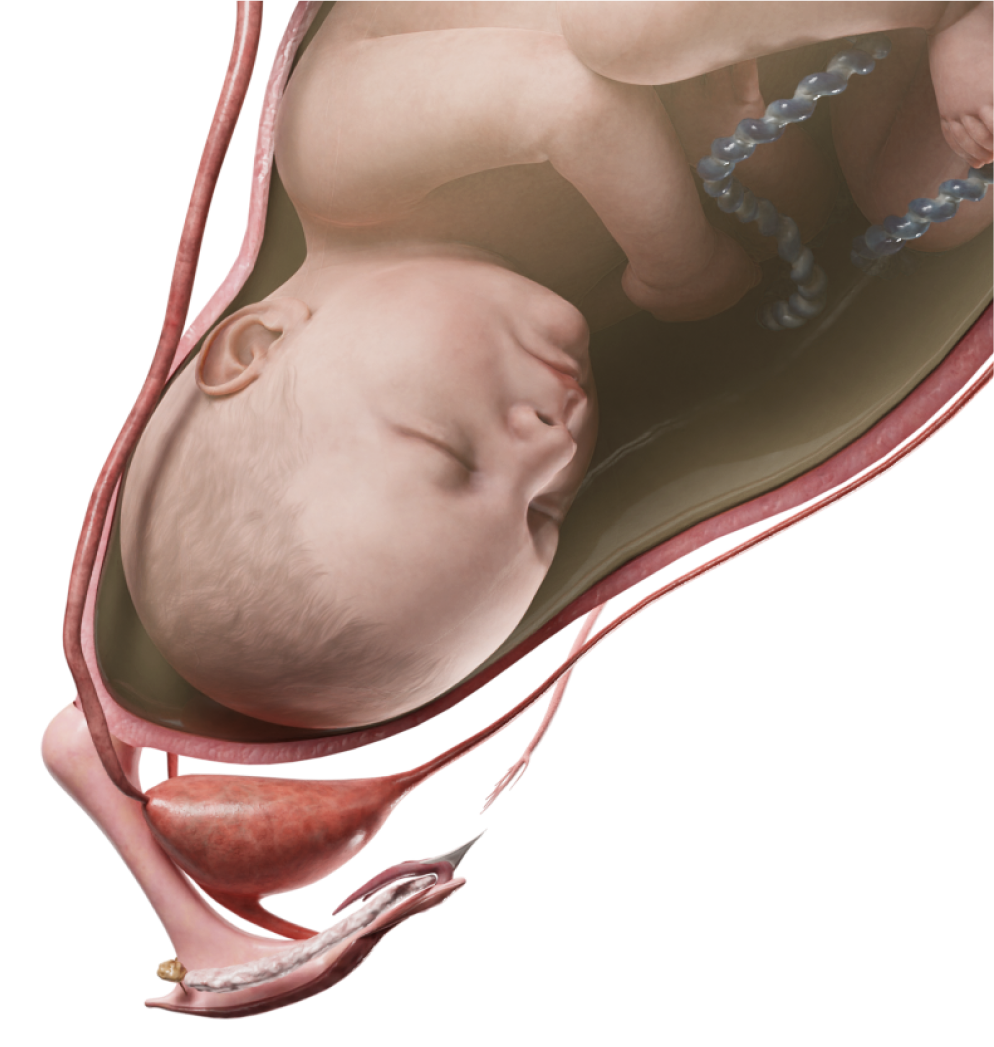
Breech presentation occurs when the fetus is in a longitudinal lie, with its buttocks or feet presenting first as it moves through the birth canal. At week 28 of pregnancy, the incidence of breech presentation may reach 20 % but decrease to 3–4 % by week 38. The recurrence rate of breech presentation in the second and third pregnancies is approximately 10 % and 27 %, respectively.

Classification

Depending on the position of the legs, there are four types of breech presentation:

  • Frank;
  • Double footling;
  • Single footling;
  • Compound.

In a frank breech presentation, both fetal legs are flexed at the hip joints and extended at the knees, with the feet positioned near the face. In a double footling breech presentation, the fetus appears to be sitting with its hips and knees flexed. A single footling breech presentation occurs when one fetal leg is flexed at the hip with its foot near the face, while the other leg is flexed at both the hip and knee, as in a double footling presentation. A compound breech presentation involves both buttocks and feet presenting simultaneously.

Risk Factors

The most common clinical conditions or processes leading to breech presentation typically impact fetal mobility or the vertical axis of the uterine cavity. These include:

  • Anomalies of the paramesonephric ducts, or Müllerian ducts: Septate uterus, bicornuate uterus, etc.
  • Placentation anomalies: Placenta previa, where the placenta occupies the lower portion of the uterine cavity.
  • Uterine fibroids: Large fibroids are generally located in the lower uterine segment, interfering with the fixation of the presenting fetal part.
  • Prematurity.
  • Aneuploidy and neuromuscular disorders: These conditions tend to cause fetal hypotony and inability to move effectively.
  • Congenital abnormalities: Examples include fetal teratoma, fetal goiter, etc.
  • Polyhydramnios.
  • Oligohydramnios.
  • Weakness of the mother’s anterior abdominal wall.

Complications

The risk of umbilical cord prolapse correlates with the type of breech presentation. Thus, the umbilical cord prolapse may occur in 15–18 % of cases involving double or single footling presentations but only in 0.5 % of cases with frank presentation.

Diagnosis

Breech presentation is typically diagnosed through Leopold's maneuvers during obstetric and cervical examinations after week 36 of pregnancy. The fetal head is round, firm, and mobile; beneath the head, a depression may often be felt, indicating the transition to the neck region. By contrast, the buttocks are larger in volume, less firm, and less mobile than the head. During a vaginal examination, the presenting part is typically not fixed, and the soft tissues of the buttocks or a foot may be identified. During labor, a soft mass can be identified, separated by the intergluteal cleft. The sacrum, a rigid structure, may also be palpated. After the rupture of membranes, the anus may be palpated at the center of the intergluteal cleft. In a footling presentation, a foot may be palpable. Clinically, the diagnosis may be challenging, as the arms may be mistaken for feet, and the face may be confused with the buttocks. Ultrasound is the most precise method for confirming a suspected breech presentation. An ultrasound examination record should include the type of breech presentation, degree of extension, estimated fetal weight, amniotic fluid volume, placental position, and any identified malformations.

Women with a confirmed breech presentation at week 36 of pregnancy or later should undergo an assessment to determine the appropriate delivery mode. In such cases, a healthcare professional should take into account individual risks, obstetric history, gynecological disorders, and general medical conditions of the mother.

A differential diagnosis is based on the following criteria:

  • Face or brow presentation;
  • Fetal malformations;
  • Antenatal fetal death;
  • Multiple pregnancy;
  • Oligohydramnios;
  • Pelvic abnormalities;
  • Uterine abnormalities.

Management Strategy

Women should be informed about the potential risks and complications.

  1. Vaginal birth with breech presentation is associated with a higher risk of perinatal death (2 per 1000 neonates). This rate is significantly lower in cases of cephalic presentation and elective cesarean section (1 and 0.5 per 1000 neonates, respectively).
  2. A cesarean section performed at weeks 28–31 6/7 has demonstrated a reduction in perinatal morbidity and mortality compared to vaginal birth within the same period. However, these rates are comparable across different delivery modes at weeks 32–36.
  3. Vaginal birth is associated with a higher risk of a lower Apgar score at 1 minute and short-term complications, although long-term outcomes remain comparable.
  4. In contrast to an elective cesarean section, successful vaginal birth carries a lower risk of postpartum complications.
  5. Epidural analgesia is not contraindicated during vaginal birth but may necessitate additional obstetric manipulations during labor.
  6. Induction or stimulation of labor is not recommended.

The following criteria must be met for a vaginal birth:

  • There are no other indications for a cesarean section;
  • There is no evidence of antenatal fetal death;
  • Ultrasound has not revealed any signs of hyperextension;
  • Fetal weight does not exceed 3600 g;
  • The fetus is not underweight;
  • The medical history does not include a previous cesarean section;
  • A healthcare professional trained to manage a breech presentation should attend.

Vaginal birth may be managed using three strategies:

  1. Spontaneous delivery: No manipulations or techniques are employed to extract the fetus. This strategy is commonly used in premature births.
  2. Obstetric delivery: This is the most widespread method. Once the buttocks emerge and the umbilical ring becomes visible, a specialized technique is used to extract the scapulas, arms, and head. An episiotomy (a surgical incision of the perineum) is a must. Traction should not be performed before the umbilical ring is visible. Once it is, delivery should be assisted in coordination with contractions. The Pinard maneuver may be carried out if the fetal legs are difficult to extract. In this technique, pressure is applied to the popliteal fossa. The knee is flexed, and the fetal leg is extracted medially.
  3. Complete fetus extraction: Tsovyanov maneuvers I–II as well as manual aid may be performed depending on the type of breech presentation. This approach aims to maintain the natural fetal attitude and prevent prolapse of the fetal legs. Assistance is provided as soon as the buttocks emerge.

Tsovyanov maneuver I: The obstetrician stabilizes the fetal buttocks and legs with both hands, mimicking an elongated birth canal. The fetal body is initially directed superiorly, up to the lower angle of the scapula. Then, the healthcare professional moves the buttocks inferiorly, pulling them toward themselves and in the direction of the fetal anterior hand. As the fetal body is directed upward, the posterior hand is delivered. Following the internal rotation of the head and fixation of the suboccipital fossa, the fetal body is delivered in the direction of the mother’s abdomen.

Tsovyanov maneuver II: This method is used to convert a breech presentation into a compound presentation. The obstetrician closes the perineum with one hand and an aseptic drape. The maneuver continues until the fetal buttocks descend to the pelvic floor and align with the level of the fetal legs. Standard manual assistance is then provided.

Standard manual assistance should also be preferred in the following cases to facilitate the delivery of the head and shoulders:

  • Footling presentation;
  • Compound frank-footling presentation;
  • Cases in which the limbs prolapse or lag, and the head is difficult to extract. This assistance should only be performed if the fetal body has been delivered to the level of the inferior angle of the scapula.

Initially, the arms are delivered. The obstetrician should grasp the fetal legs by the ankles using the hand contralateral to the fetal arm. The fetal body is rotated toward the anterior superior iliac spine of the mother opposite to the fetal back. Using the index and middle fingers, the obstetrician extracts the fetal arm in stirring motions while applying pressure to the bend of the arm. The other arm is delivered in the same manner.

The head is delivered via the Mauriceau — Levret maneuver (also known as Lachapelle maneuver). The fetal chest is supported in the obstetrician’s hand. The obstetrician places their middle finger into the oral cavity of the fetus, while the index and ring fingers rest on the maxilla. The fetal back, shoulders, and occiput are stabilized with the other hand. Thus, the index and ring finger are placed on the shoulders, while the middle finger is located in the region of the suboccipital fossa. Both hands are used simultaneously to flex the fetal head, causing the body to shift superiorly. Note that each step should be synchronized with uterine contractions. In the Mauriceau — Smellie — Veit maneuver, another method for fetal head extraction, the middle finger is placed on the maxilla rather than in the oral cavity.

The success rate of external cephalic version (ECV) ranges from 35 % to 86 %. Better outcomes after the procedure are primarily associated with earlier gestational age and purely frank presentation. Experts hold varying opinions on the impact of maternal weight, placental position, and amniotic fluid volume. However, the majority of practitioners believe that ECV is more likely to be successful in multiparous women, women with a normal body mass index, a placenta located along the posterior uterine wall, and a sufficient amount of amniotic fluid.

Procedure-related risks

A temporary decrease in the fetal heart rate (observed in up to 40 % of cases) is the most common complication. This condition may persist for several minutes after the procedure and does not have adverse consequences for the fetus. Rare complications include fetal bone fractures, premature rupture of the membranes, placental abruption (if the placenta is normally located), hemorrhage, and uterine laceration. Currently, there are limited studies to confirm whether the overall risk of perinatal death is higher following ECV. A 2015 Cochrane review reported that the risk of perinatal death among ECV patients was 2 out of 644 cases, compared to 6 out of 661 cases among women who did not undergo the procedure.

Procedure

Before the procedure, ultrasound is performed to assess the fetal lie, weight, and amniotic fluid volume. It also helps exclude placenta previa and developmental abnormalities. A nonstress test (a biophysical profile as an alternative) is also mandatory prior to ECV. The procedure is conducted in an operating room under the required supervision of intensivists. Routine tocolysis, and spinal or epidural anesthesia is not recommended.

ECV is carried out by gently guiding the fetal cephalic pole toward the woman’s pelvis while shifting the fetal pelvic pole toward the uterine fundus. There are no specific recommendations regarding the number of ECV attempts. Regardless of the outcome, a nonstress test (or a biophysical profile, if needed) should be performed following the procedure. Moreover, Rh-negative women should receive Rh immune globulin. After a successful procedure, labor should not be induced. A patient is discharged and then admitted to the hospital after the labor onset or if medically required.

Cesarean Section

Elective cesarean section should be performed at ≥ 39 weeks of pregnancy. This term is considered optimal for physiological development of the fetus. However, some complicated cases may require preterm delivery.